
It does not answer questions.
It does the analyst’s whole day.
Ask it anything in plain English and it reads every source it collects for you as one thing, then puts a numbered source against every claim. Ask it something big and it plans the research itself, reads hundreds of documents, checks each claim against a second source and hands you a brief. Ask it nothing at all and it still works.
Everything you know, in one index
Our AI research across credible sources - filings, job boards, newsrooms, pricing pages, registers - read as one index. One question, one answer, every claim numbered and openable.
One question, fifty companies
Ask it once and get a filled table instead of fifty tabs. Every cell carries its own citations.
A twenty-page brief while you make coffee
It writes its own research plan, reads at a scale no person can, verifies twice, and shows its working the whole way.
The night shift re-asks everything you asked
Overnight, on the questions you asked last week - waking you only when an answer has changed.
Where the next revenue is
Every signal is connected to the markets next door, so an opportunity in a category you do not sell to yet arrives before it is obvious.
The only one that finishes the job
Research platforms stop at the answer. This one drafts the email, updates the record, renders the deck and sends it.
Research platforms in this category are sold by the seat or by the report, negotiated once a year, with the AI as next year’s upgrade. This is one price, unlimited asking, and every model improvement lands in your plan the day we ship it.
One engine in the middle. Everything else is delivery.
Read it from the inside out - what it reads, what it makes from that, and who or what receives it.
Inner ring - what it reads
Middle - what it makes
Outer ring - who gets it
Eight kinds of person and three ways out, each with its own threshold and rhythm. Open the tabs below to see exactly what reaches each one.
The whole path, end to end
Read it left to right: what it reads, the one graph it all lands in, and who receives what comes out.
Nine kinds of source in, and three ways out: the email brief, the workspace, and a file you can put wherever you already work. No second app to buy, no pipeline to build, and nothing to configure beyond telling it what you care about.
Name three companies. Get the market around them.
Most tools hand you back the list you gave them. QuikSignal draws the ecosystem: who competes, who sits adjacent and is therefore the next thing they buy, and what has only just appeared.
You name three companies. What comes back is the market around them - who they compete with, who sits adjacent, and who has only just appeared. Signals land on the map as they are found, each one carrying the document it came from.
- Payments
- Payroll & HR
- Data infra
- Logistics
- Compliance
- Centre
- The companies you named
- Inner ring
- Rivals and adjacent buyers, found for you
- Outer ring
- Newly appearing - absent a quarter ago
Example intelligenceThe companies on this map are invented, so the shape of what comes back can be shown without borrowing a real subscriber’s market. In your workspace every node, wire and signal carries the document it was researched from.
Same engine. A different question each time.
A lens is not a filter on one feed. Each one asks its own question, opens its own screens, and researches the documents that answer it - so the Talent lens and the Revenue lens look at the same market and see different things. Pick one and follow the wires.
Which accounts are about to buy?
Funding, new leadership and disclosed pressure, against the companies you sell to.
- Pipeline briefThe accounts that moved, ranked by what changedSEC EDGARGoogle NewsGreenhouse jobsPricing-page history
- Buying signalsEvery signal that cleared the floor, with its documentSEC EDGARCompany newsroom (RSS)Google NewsGreenhouse jobsLever jobs
- AccountsFit and momentum per company, and the evidence behind bothSEC EDGARGLEIF legal entityWikidataGoogle News
- Decision-makersWho holds the decision, and the document that named themSEC EDGARGoogle NewsGreenhouse jobs
- Prospect IntelOne signal turned into a person and six touchesSEC EDGARGoogle NewsGreenhouse jobs
- Tech mapWhat each account runs on, named in its own documentsGitHub activityGreenhouse jobsLever jobsPricing-page history
- PresenceWhere you and your peers are publicly hiringGreenhouse jobsLever jobsGLEIF legal entity
- What they are hiring for2 sources
- What they state themselves2 sources
- Who they are, on the record2 sources
- What they filed1 source
- What was reported1 source
- What they charge1 source
Read once and shared. Two screens asking the same filing a different question is one collection, not two - which is why running three lenses costs barely more than running one.
5 lenses run today. 4 more are being written - Risk & ESG, Innovation & R&D, Media & PR, Partner & channel - and none of them can be switched on yet, on any plan.
Seven screens. Every one of them real.
Not mockups drawn for this page - the actual views, with the actual data model behind them, on the worked example every screen is labelled with.
What the night came to
- Read overnight
- Distinct stories−1,402 dropped
- Above the floor−100 dropped
- In the brief−16 dropped
1,522 documents read while nobody was awake. Four reached you. Every bar is the one above it after something was taken away - and what was taken away is the work.
See it on your marketWhere your market is hiring - and where you are not.
Every job requisition is a company stating, at its own expense, where it is putting people and what it is building. Read enough of them and you have a map of your market that nobody filled in by hand.
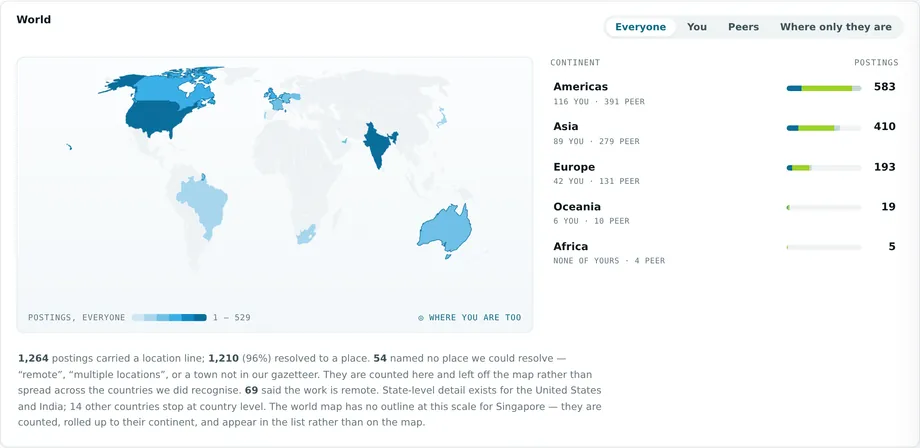
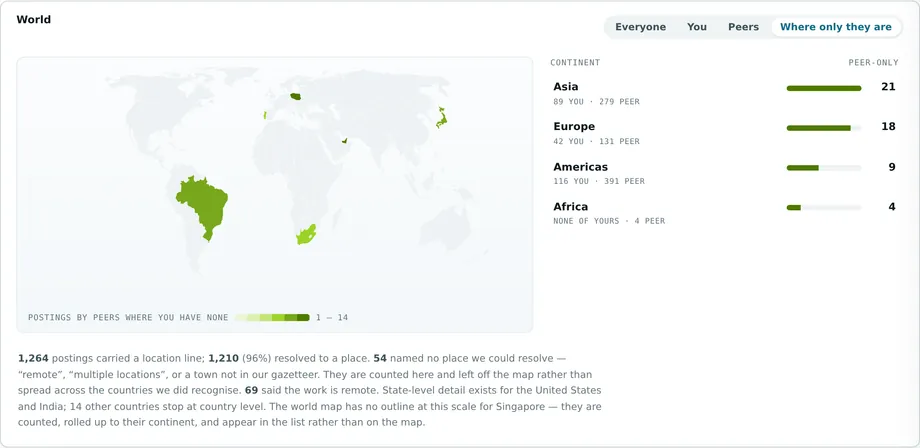
Presence is what a company has stated about where it is putting people - not where it is registered, and not where a news story mentioned it. State-level detail covers the United States and India; everywhere else stops at country level, and the screen says which.
See it on your marketOne question, taken apart eleven ways.
Not one chatbot answering one thing at a time. A question about a market is really several questions, so they are asked at once, against different sources, and merged only when each one has a source document behind it.
- 01Market researchComplete
Trade press, category coverage, regulatory registers
- 02Competitor researchComplete
Pricing pages watched for change, positioning, launches
- 03Technology researchComplete
Public code, job specs, engineering posts, filings
- 04Company researchComplete
Newsrooms, funding databases, earnings material
- 05Decision-maker researchComplete
Appointment announcements, filings, careers pages
This is a diagram of the method, not a live readout. Nothing is being researched for you on this page - the agents run inside a workspace, against the companies you name.
Who receives what, where, and how often
Sales & BD
The ranked list of who is ready to buy, an alert the morning a target raises money, and a dossier before every call.
Founders & leaders
What changed in your market this week, what it is likely to cost you, and the decision it asks for.
Marketing
Rival pricing and positioning moves, share of voice, and which campaign is losing steam.
Media & PR
Filings, departures and quiet edits on your beat, with three sources already cross-checked.
Recruiters
Open roles, pay rates, time to fill, and which rival just opened an office in your city.
Investors
The behaviours that run ahead of a raise, a sale or a cut, across every company you track.
Product & R&D
Capability showing up in job specs and releases a quarter before it shows up in products.
Your prospects
A first line that refers to something that actually happened at their company this week.
The parts people ask about
What does “every claim is numbered” actually mean?
How does deep research differ from asking a question?
What runs overnight without me asking?
What does “it acts” include?
See the platform on your own market
Same engine, your companies. The first brief is about accounts you recognise.